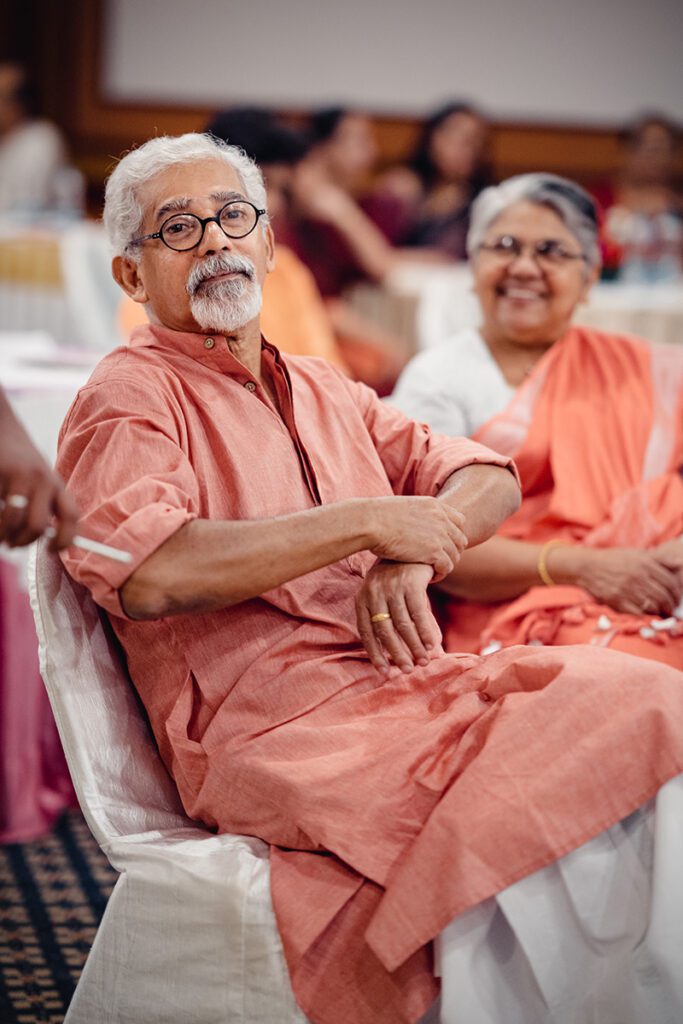
K P Thomas | Indian contemporary artist
K P Thomas is an Indian contemporary artist whose work explores memory, society, and the transient nature of materials. With an academic background in philosophy from Maharaja’s College, Ernakulam, Thomas approaches his practice as an ongoing inquiry into how communities remember, forget, preserve, and discard. This philosophical foundation gives his art unusual depth, transforming each painting or installation into a dialogue between personal memory and collective history.
Largely self-taught, Thomas gained early recognition in 1974 when his painting Mananthavadian Figures received the prestigious Kerala Lalita Kala Akademi Award. This milestone marked the beginning of a career dedicated to documenting overlooked narratives, exploring the fragility of collective memory, and critically examining social structures. Over the past five decades, his practice has maintained a consistent focus on impermanence, erasure, and resistance, establishing him as one of the most distinctive figures in Indian contemporary art.
A defining feature of his work is the innovative use of discarded and obsolete materials. Ledgers, envelopes, dot-matrix printouts, defaced documents, and other ephemera marked by previous use serve as the foundation of his artistic expression. These surfaces, imprinted with stamps, signatures, and traces of bureaucratic systems act as silent records of forgotten transactions and neglected histories. This choice of material holds both formal and conceptual significance, challenging conventional boundaries between permanence and decay, presence and absence. By transforming everyday remnants into powerful visual testimony, Thomas situates his work at the intersection of art and social archaeology.
Much of his practice centres on the indigenous communities of Wayanad, Kerala, histories long excluded from formal archives and mainstream narratives. Figures such as Karinthandan, a historical tribal leader, and the simple ways of tribal life, recur throughout his compositions. They appear not merely as individual portraits but as enduring symbols of memory, endurance, and resistance within contested landscapes. Through these figures, Thomas creates a space for reflecting on indigenous struggles and their relevance to contemporary society.
Beyond indigenous narratives, he explores broader and urgent themes such as displacement, ecological degradation, gendered violence, and political conflict. Works including Floating Head of Martyr, Fallen Flag, Dripping Colours, and Existence in Pandemic Times exemplify his ability to transform pressing social issues into a compelling visual language. His art balances personal witness with social critique, encouraging viewers to consider the human condition and the structures of power that shape it.
Thomas’s artistic style is marked by a restrained yet expressive use of line, texture, and colour. From deep blacks and earthy ochres to subdued reds imbued with symbolic meaning, his palette carries a sense of weight and history. A recurring motif, the paradoxical faces, functions as a marker of vigilance and ethical awareness, a silent observer of unfolding events. This symbol reinforces his role as both witness and participant in the stories he tells.
Today, his paintings are held in private and public collections across Europe and Asia and have been featured in more than 25 solo exhibitions. Each exhibition reinforces his reputation as a contemporary Indian artist committed to representing forgotten histories and questioning social norms.
The career of K P Thomas embodies a philosophical commitment to the role of the artist as a witness, someone who collects fragments of the world, illuminates them, and encourages viewers to consider what endures, what disappears, and why.
Follow K. P. Thomas on Social Media
K. P. Thomas Facebook Page K. P. Thomas Instagram Profile K. P. Thomas Wikipedia Article